Poverty and Immigration, a pediatrician's perspective

One of the pediatric patients who visited us in the clinic this week was a sweet, healthy 4-year-old.  He was brought in by his grandpa.  I don’t see too many toddlers in my clinic in Colorado who are accompanied by their grandpa, which prompted me to ask more questions about his living arrangements.  This little boy is being raised by his maternal grandparents.  Grandpa shared that when his daughter was 17, she became pregnant.  The father of the baby was a much older man.  He came to their home and convinced the family he was honorable and would take care of her and the baby.   After the baby was born the grandparents found their daughter and grandson were essentially being trafficked by this man.  There were 5 other women and their children living with them.  The grandparents were able to get their daughter and infant grandson out of that situation and back home with them.   Not long after the grandpa had some health issues, making him unable to work, so the young mother made the difficult decision to head north. Someone needed to make money to support the family.  Thankfully she successfully immigrated to the USA and is sending money down to support her parents and toddler son.   Let’s hope ICE doesn’t find her.   This is the typical story of most immigrants.  Life circumstances become so unbearable that they seek out a better life for their family.   


People immigrate for so many reasons.  Sometimes things like war or local conflicts push people away.  Climate change is certainly playing a part.  The last few years I can see the effects of climate change in Guatemala.  Corrupt governments that don’t support systems that allow for people to raise families in economically stable and safe communities are probably one of the biggest drivers of migration.  Once you have seen what extreme poverty looks like and the challenges it brings, it is not hard at all to see why someone would make the very difficult choice to leave everything they know in search of a better life.  I can honestly say that I would be honored to have any of the patients we saw this week in clinic as my neighbors.  


Even the trip north itself is incredibly dangerous.  Earlier in the week there was a father of 3 children who came to clinic.  Several months ago he went north to better provide for his children.  In Mexico he fell out of the bed of a pick up truck and severely injured his right arm. He is now an amputee and back in Guatemala with his family, unable to find work so he cannot provide for them at all.   


Each time in our debriefs as I was listening to these stories of poverty necessitating these drastic upending of lives, I found myself thinking about Gustavo Gutierrez - a Peruvian priest and founder of liberation theology, who died last fall.  When my husband, Chris, was getting his PhD at Notre Dame, he had the privilege of having Gustavo as one of his theology professors.  Our family got to know Gustavo well those years and were honored that he came to our home a few times to say  mass for “house church.”  Our daughter Grace was an infant at that time. Gustavo adored her and she was fascinated by him.  Gustavo was a tiny Peruvian.  Think Yoda in human form. Gutierrez wrote about the preferential option for the poor.  It is a key principle in Catholic social teaching that emphasizes the moral priority of addressing the needs of the poor and marginalized.  It means prioritizing the well being of those most vulnerable, not just through charity, but through systemic changes to address the root causes of poverty and marginalization. 

Fr Gustavo Gutiérrez, our daughter Grace, my husband, Chris 2004

Poverty is not accidental but the result of structural and historical events that systematically makes it impossible for those at the very bottom to get out.  To quote Martin Luther King, Jr ,”It’s alright to tell a man to lift himself by his own bootstraps, but it is cruel jest to say to a bootless man that he ought to lift himself by his own bootstraps.”  Our community in Guatemala is bootless.  The only way to confront poverty is to remember we live in one world, not three.   Guatemala, and places around the world like it, is not “the third world.”  There really is only one world and we are all connected.


In recent years, it has been a welcome relief to have had Pope Francis stand firmly against the mass deportation of human beings around the world during his pontificate.  He was a vocal critic of the demonization of the other that is the root of right wing immigration policies around the globe.  Pope Francis will be dearly missed.  I wrote to the students shortly after his death that I suspected we would actually be in Guatemala during the conclave.  So when the white smoke appeared on Thursday morning while we were in clinic, we were happy to learn that Pope Leo XIV was chosen.  From what we are learning in these early days of his pontificate he also appears to be a strong advocate for refugees and immigrants.  I suspect his decades of serving the marginalized in Peru has shaped his conviction on this from real world experience.  

When our politics focus on demonizing the other and making us fear the other, we start to see them as less than human.  I can tell you that a 17-year-old new trafficked mom is fully human and is only doing what any mother would do for her child. Today is Mother’s Day in the US - it was yesterday in Guatemala.   On these special days I find myself honored to have met this little 4-year-old boy who is so loved by his mother  she went north to find work so she could support him. I hope our world can come together to solve the problems that forced her to have to leave her community in the first place. 

Lauri Pramuk, MD

One of the many special moms I saw this week. Deysi shows up every day for her wonderful boy
Another incredible mom I was able to see again this week.  Luz loves Sebastian so tenderly


La Vida Continua


On the second day of clinic, Mary let me sort through a pile of stickers in Spanish to see if I liked any of them. After a few seconds of using my limited knowledge of the language, one jumped out to me immediately. It read “la vida continua,” or “life continues,” in colorful letters underneath a multicolored graphic of the “take it easy” symbol, the pinky and thumb pointed in the universal gesture. I decided to stick it onto my water bottle, and seeing it there, permanent until I remove it, made me reflect on my time at Ciudad de la Esperanza thus far. 


When I was at the glasses station assisting patients to fit the best fit for them, I thought about how long they must have gone without being able to see the world with clear vision. An older woman sat patiently waiting for Antonio and I to start her eye exam, and when we finally got to her, we were at a standstill. We couldn’t find glasses that would better her vision without harming it in the long term. While Antonio conversed with the woman, I restocked the table full of glasses in hopes to find a better pair. I put a pair of kid sized glasses on the table, not thinking much of it, but those in the end were the perfect fit for her. After some bending of the frames, she stood happily and held up the sign for “perfect” in my direction. Antonio and I watched her walk away, and we looked at each other saying that those glasses were meant to be for her.


I ended my day stationed with Dr. Deb, and even though it was a slow day, I felt more confident to pursue physical therapy for my career. We saw more patients later in the afternoon, but two of them stuck out to me the most. One came in regarding pain in her knees and ankles, products of long days of work to earn money and care for her husband. The other was similar, and carried years of stress in her back and shoulder blades from the hard work she completed at her job. Both had to quit their jobs because the pain was unbearable, but this stress was barely visible as they cracked jokes and listened attentively to Dr. Deb’s instructions. After their treatment was complete and I walked them towards the exit, they gave me warm hugs and we exchanged wide grins. 


The people of Cobán are a smiling and loving symbol of the phrase now on my water bottle, and I am incredibly grateful to share in their light. Despite any hardship, they continue their lives with the widest smiles. Nothing beat the crinkling of their cheeks, dimpled with smile lines, as they took my hands in theirs in gratitude. Truly though, I will forever be the grateful one for the lessons they continue to teach me, not through words, but with their actions and bright expressions. La vida continua.


All my love,

Samantha Manlapig


The Power of Personal Stories

 As the second day of clinic rolled around, everyone began to settle into their groove. We overcame the first day jitters, and not having to unpack anymore was a bonus! Even though today was a new rotation for each of us, we felt more confident starting the day. We had a better understanding of how clinic works, and we had each other’s help and advice for some of the more daunting rotations. 

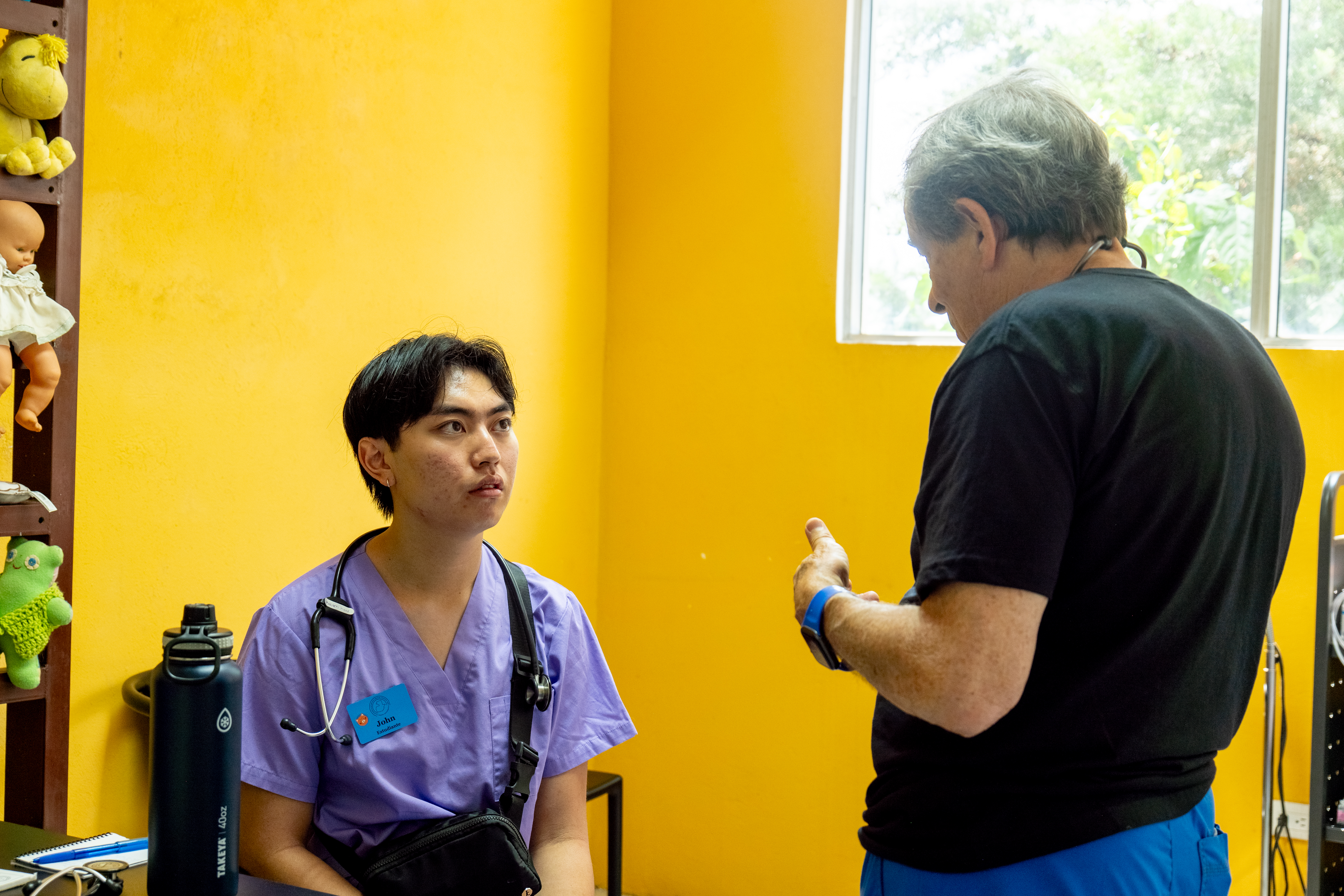
     For me, my second day started with walking through Dr. Richard’s door and being greeted by his and Mishel’s smiles. It was an unforgettable warmth that would ease any patient’s worries. Throughout the day, it was fascinating to listen to and participate in Dr. Richard’s physical exams. From neurological exams to palpating the abdomen, there were so many signs that he could deduce and help guide him toward a diagnosis and treatment plan. But above all, the most helpful care that he provided was lending an empathetic ear to each and every one of his patients. No matter the circumstances, he explored each patient’s personal story and emphasized that during this appointment, they were the center of attention. The most impactful part of shadowing Dr. Richard was not learning a medical skill or fact but rather practicing how to sincerely listen to someone and see them as a whole individual. For some, these appointments were an infrequent occasion that could be several hours away from home, so it was crucial that we made each moment worthwhile and thorough.


     Before I knew it, the afternoon had already arrived, and I was soon placed into triage. We had already practiced these skills  at our mock clinic, but it still felt nerve-racking when the first patient came in. I felt a mix of anxiety and guilt for not practicing my Spanish and triage skills enough, but these worries soon melted away. Many of the patients already visited the clinic in the past, so they already knew what to do. Instead of me guiding them through their vitals, they held out their arms and rolled up their sleeves as if they were teaching me how to perform these tasks. It was a relieving moment that gave me the confidence to help new patients through triage, such as a young boy who was waiting to see Dr. Lauri. It was cute to see him imitate the patients before him by holding out his arms, but he was scared of the thermometer. After explaining the machine to him and taking his temperature, his frightened eyes opened back up and looked surprised. Nothing had happened, and he let out a big grin as he hopped off the chair. It was a simple moment that opened the accessibility to healthcare for him and his family by demystifying some of it.


     Overall, today was an opportunity to feel more comfortable by practicing my Spanish and breaking down language barriers. A large part of the latter is showing the patient through actions and body language that they are recognized and heard even if we don’t completely understand each other. This passion is something that I will incorporate into my education and career path since giving each other a little more grace could do something as great as moving mountains.


-John Nguyen


Day 1

Today was the very first day of the trip we've been preparing for all year. It felt pretty surreal, to say the least. I've been so incredibly nervous about leaving - I've never gone out of the country independently until now...and all the sudden it's here. We're doing it.

After packing up all of the clinic donations at Regis, the group headed out to DIA to start our journey. I'm not going to lie, I don't think my anxiety let me out of its grasp until we got to Atlanta. I was so nervous about all of the unknowns, that I found myself praying for a sign that l'd be okay. A sign that I was on the right track. By some strange force, I think I received just that. When I walked into one of the airport shops, still groggy and heavy with sleep, a single book stood out on the shelf before me that just simply said, "Trust God." There it was. Exactly what I needed to hear in that moment. And after being so dead tired, sleeping for many hours on the airport floor with nothing but my backpack as a pillow, I began to see the sun rise and I knew everything was going to be okay.

I ended up sleeping the whole flight from Atlanta to Guatemala, and felt so much more energized once we arrived. Reuniting with the rest of the medical team was a highlight - I was so glad to see everyone in person again. I felt immediately at home. We all made it through customs pretty smoothly, and were finally off on a very long bus ride to Coban. By the time we sat down for a meal together at the hotel - the first real meal I'd had in nearly 24 hours - it felt like the world was finally falling into place.

Recently I've been in a place where I’ve felt like l've been so stuck in my ways. I've felt trapped, like I'm nothing but a passenger in my own life. I applied for this trip because I wanted to change...and I know this place is going to change me. It's only been a few hours now, but honestly? I think it already has.

Mason L


Threads of Hope

 Today was our first day at clinic!  After passing the green, forested hills, I could see the large blue Ciudad de la Esperanza mural peeking out from behind the gate; I felt myself smile, wide. It was finally here, all the prepping, fundraising, packing, and traveling we had done had finally paid off. We made it! We had some loading troubles with the van and ended up parking outside the gates to unload. But as we walked into the city we were greeted by a chorus of little voices happily welcoming us. They’re little “Buenos Dias!” was so filled with joy that we couldn’t help but smile, wave, and laugh with them. 

After unpacking all of our supplies, I spent the morning with Dr. Lauri, in pediatrics. I met some of the most beautiful families and some of the cutest kids. One patient that I will remember forever was a little boy. He was eight years old but small for his age and he was carried in by his mom. One of the first things I noticed was that they both were wearing navy blue polka button up shirts. He was so curious about his environment, he wanted to play with the curtain and a little turtle toy that he likely got in the waiting room. After Dr. Lauri worked her magic, she diagnosed him with cerebral palsy, a neurological disorder that occurs when the brain doesn’t receive enough oxygen at birth. But what really stood out to me is that the little boy’s mother didn’t know he had cerebral palsy, she knew he was different, but she had simply been caring for him the best that she could, in the way that he needed. This year was the first time that they had been at the clinic. 

The little boy’s mother had heard from a friend that we would be here and decided to bring him in. Later that day, the boy and his mother were able to be seen by Dr. Deb in PT.  Thanks to project cure, this family was given a wheelchair that would help him move about more on his own and prevent his mother from needing to carry him everywhere.  Another amazing thing about this little guy is that he loves music. Ms. Marie gave him a speaker and his smile could not have been wider. 

I also spent the afternoon in the pharmacy with Dr. Eric. I learned how to count pills and write prescriptions. I also got to pray with every single patient that we gave medications to. My Spanish was subpar at best, but everyone was so patient and kind with me. When we all put our arms around each other, closed our eyes, and prayed, I felt so heart warmed and connected with them in such a profound way. 

One of the greatest things I learned today is that the Ciudad de Esperanza’s clinic is more than just a clinic, it represents hope. For many patients, the clinic is life changing, from finding a pair of glasses, to gaining access to life changing medicine they couldn’t otherwise afford, and for the little boy and his mother. Who had heard about our clinic from a friend and decided to travel half an hour to the clinic to see if we could help her son. All of that is impossible without hope. I feel so lucky to have been, in Dr Stephanie’s words, “a small thread” in such an amazing project and being able to meet such an amazing, resilient, joyful, and hopeful community here in Guatemala. 

Sam Matterson 


Finding Harmony en La Ciudad de la Esperanza

 Today was my first day at La Ciudad de la Esperanza and I already feel like I’ve gained a lifetime of memories. Walking into the clinic, I was amazed by the abundance of laughter and vibrant colors that characterized the space. I started my day on the physical therapy rotation with Dr. Deb, where I got the chance to assist patients in their rehabilitation efforts. It was amazing to see them persevere through their pain and push themselves to improve. However, there was one patient in particular who truly made my day unforgettable.


I had the privilege of meeting a patient that was new to the clinic. He is an eight-year-old boy with cerebral palsy, and has the brightest smile. His mom explained how she carried him around 24/7, making it difficult to complete various tasks throughout the day. We were able to give him the last children’s wheelchair, ultimately helping his mother and giving him a new means of transportation. My heart completely melted when we gave him that wheelchair. It was red and matched his sneakers perfectly. We also learned that he loves music and listening to music helps him calm down when he is upset. We gifted him and his mom a speaker to listen to his favorite songs. He immediately pulled the speaker to his ear, nodding his head to the beat. Watching his face light up as he rode in his wheelchair while listening to his favorite tunes was such a beautiful moment.


Later in the day, I moved to the pharmacy rotation, where I had the chance to connect with even more patients. We shared prayers and laughs, and it was so humbling to experience the gratitude they expressed.


As I reflect on my first day, I feel overwhelmed with gratitude and excitement. I can’t wait to see where this journey takes me and how I’ll grow as both a student and a person. This experience has already opened my eyes to the power of human connection and how little things can make a world of difference in someone’s life. The little boy’s passion for music reflects how we can all find harmony in life’s simplest moments. Similar to how one note is essential to a song, each small joy shapes who we are.


Con amor,


Ava DeBell